

Marcus felt cornered.
His stomach acid had become like some wild animals — unpredictable and destructive. He was suffering, despite a fundoplication surgery years before, meant to repair a hiatal hernia and reinforce the dysfunctional barrier between his stomach and esophagus. Unfortunately, the barrier continued to fail, and acid continued to leak through.
Of course, surgery had not been the first choice. Proton pump inhibitors (PPIs) are standard care for reflux disease, and they had been tried first, in an effort to suppress the acid and quell Marcus’s suffering. They were meant to protect his tender esophagus from corrosion.
However, there is a difference between suppressing an animal and helping it to live more fully, according to its nature. Stomach acidity is not inherently harmful, and it has important digestive and immunologic functions. From that standpoint, the culprit was not really the acid. It was the reflux. The issue is that standard medicine has surprisingly few tools for preventing it without suppressing normal gastric acidity. This is the essential compromise.
When surgery did not help Marcus, the gastroenterologist had no choice but to return to reducing acid production. When I finally met Marcus, he was on twice the normal dose of Omeprazole. It eased but did not stop a daily, burning pain. For Marcus, though, what caused him to schedule a consultation was not his thirty years of reflux disease. It was that years of reflux had produced esophagitis and eventually Barrett’s esophagus — a form of pre-cancer. This diagnosis worried him deeply.
Where This Case Began
30 years of reflux
→ Failed fundoplication
→ Twice-normal PPI dose
→ Experiencing daily burning
Four Weeks Later
Burning substantially improved
→ PPI dose cut in half
→ Bowels moving daily
→ Less abdominal pain and bloating
→ Better sleep, energy, and mood
→ Less phlegm in the throat
→ Visible improvement in the tongue
When our appointment started, Marcus seemed relaxed and easy-going. Yet, beneath this appearance, he had been struggling for a long time. Besides the upper digestive symptoms mentioned, he also had chronic constipation and had been diagnosed with IBS-C.
A dysfunctional esophageal sphincter, chronic constipation, and ironically, low stomach acid — all are known contributors to reflux disease and likely were in Marcus’s case. The question easily becomes: How can these distinct issues be approached, as parts of a broader decline in digestive function? We might expect a question like this to be answered through comprehensive and holistic treatment.
Interestingly, though, the treatment that helped Marcus did not focus on any of these issues directly. It didn’t even focus on reflux. Instead, it was designed to improve a broad physiological pattern across organ systems.
Marcus’s Symptoms at the Time of Treatment
- hard, dry stool; bowel movements every 2-3 days
- bloating, especially after eating
- burning in stomach and esophagus, worse at night, but without regurgitating acid
- strong appetite, especially at night
- gnawing feeling in stomach that improves after eating
- dry mouth but easily quenched thirst
- irritability and a short-temper, especially when not eating
- frequent upper abdomen pain – a sore, raw feeling
- hot flushing at night, especially in the upper abdomen
- excessive phlegm stuck in the throat — thick and clear when expelled
- sometimes light-headed or dizzy
- easily fatigued
- poor and interrupted sleep
- inflamed gums
- purple lips
- hesitant urination
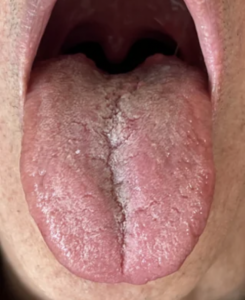
Marcus’s tongue before treatment:

Tissue Issues
Marcus’s tongue was red and peeled. Most of its normal papillae (“tongue coat”) were missing, and a long, deep midline crack with transverse cracks had formed. Some swelling could be seen through the middle. It was looking dry, stiff, and poorly nourished. Traditionally, they would say that it lacked “spirit.”
Our digestive tract should be flexible and resilient. The actual tissue — the cell walls of a person’s stomach, intestines, etc. — must maintain their integrity and barrier function while continuously handling food, digestive chemicals, microorganisms, mechanical forces, and inflammation. One impediment in the treatment of chronic digestive cases is that we can measure aspects of the tissue, but there is no single measure of its overall condition — how well it is nourished, protected, regulated, and able to repair itself. These qualitative aspects often go uncharacterized, but they affect digestion.
In contrast to the ideal of flexibility and resilience, Marcus’s tongue was beginning to look like an old, dried-out piece of meat. The word that comes to mind is “depleted.”
Is it possible that the tissue of Marcus’s digestive tract (upper and perhaps lower) was losing the ability to properly produce important digestive chemicals, maintain a protective mucosal layer, handle stress-induced inflammation, support normal motility, and that aspects of these pathologies could be perceived through the depletion and dry-malnourishment visible on his tongue?
What happened during the first month of treatment gave considerable support to this interpretation.
The First Formula
Marcus’s concerns were primarily: burning pain, Barrett’s esophagus, and constipation.
However, his tongue image and many of his other symptoms pointed towards a broad pattern of dryness and malnourishment, especially in the upper digestive tract. This is often called Stomach yin deficiency with Fire in Eastern medicine, and in this case, it was the low-hanging fruit. More importantly, it seemed to be a clear point of entry into an otherwise complex situation.
The immediate strategy was to clear the excessive heat while restoring fluids and nourishing the depleted tissue. To do this, I prescribed Yu Nu Jian — Jade Woman Decoction — substantially adapted for Marcus’s case.
This was the initial custom formula in grams of 5:1 powdered extract per week — Rx: 1.1
| Shi gao | Gypsum | 12.4 |
| Mai dong | Ophiopogon | 12.4 |
| Di huang | Rehmannia | 9.9 |
| Shan yao | Dioscoria | 9.9 |
| Zi su zi | Perilla seed | 5.4 |
| Zhi mu | Anemarrhena | 5 |
| Mu dan pi | Moutan | 2.5 |
Initial Improvement
After two weeks, Marcus reported that the formulation was having an effect.
Specifically he saw:
- Improved mood, sleep, and energy
- Bowels moving daily
- Less pain in the abdomen
- Less bloating
- Continued hunger in the middle of the night
- Much less burning stomach at night; less feeling of heat at night
- Continued dry mouth at night
- Decreased phlegm in his throat
- Urine flowing better
The tongue became less red. It began to look moist, and even wet. Papillae began to emerge. Unfortunately, the middle swelled even more and that crack down the center had only improved a modicum.
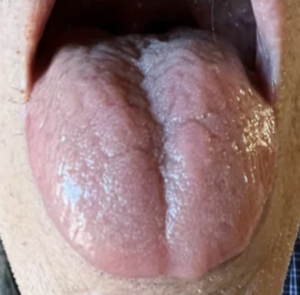

Although the formula was working, that swelling through the middle and the overall wetness suggested that side effects were just around the corner. Marcus’s body had worsened in its accumulation of fluids, even though there were no symptoms yet. I adjusted the formulation by adding one herb — Fu shen/Poria fungus — and prescribed it for another two weeks. This herb is a diuretic that percolates dampness from the body via the urine, essentially draining the swamp. It has the added benefit of “calming the spirit” and reducing irritability. At this point, because he had long worried about being on a high dose of Omeprazole, Marcus also started decreasing that dose.
After four weeks, the tongue had become a pale red. Swelling in the middle had gone down again, which seemed to also make the center crack shallower. Now the tongue wasn’t wet, but it showed a healthier moisture, as if his body was integrating fluids rather than just moving them to the surface. The lips were also less purple. These changes are mostly positive and occurred simultaneously with improvements in Marcus’s condition.
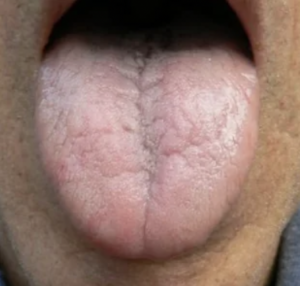
Because burning pain was the “main complaint” in this case, it is worth noting that it was substantially improved, despite cutting the dose of Omeprazole in half.
Some Useful Patterns for Understanding the Case
Marcus already had several diagnoses — GERD, IBS-C, and Barrett’s Esophagus — and we might have speculated about some of the underlying physiological causes involved. However, this was not enough scaffolding to improve his health.
Patterns are recognizable physiological states, usually identified through constellations of symptoms and signs, and they can provide additional framing to more fully build out a case. A chronic condition will typically present with 3-5 patterns simultaneously. However, two patterns stood out for Marcus in particular: Stomach yin deficiency with fire, which has already been mentioned, and Spleen qi deficiency.
What East Asian medicine calls Stomach yin is not a substance. It is a label that circumscribes a network of activities that keep digestive tissue nourished, hydrated, protected, regulated and repaired. These include glandular secretion, mucosal barriers, adequate blood flow, epithelial regeneration, digestive motility, and inflammatory regulation. Its depletion is most easily seen as a dry mouth, dry stool, and a “gnawing” feeling improved after eating. Yin deficiency symptoms are also often worse at night.
Fire describes another side of the picture: it describes iterative processes that irritate, excite, inflame and consume those same resources. Chronic emotional stress can contribute to this state, and Marcus was chronically stressed. On the psychological side of things, fire can show as anger, agitation, and a short-temper. Physically, there is often gum inflammation, burning pain in the stomach or chest, insomnia, and an unusually strong appetite.
The other primary pattern was Spleen qi deficiency. When Marcus first came, this deficiency was both difficult to perceive and inappropriate to treat directly. I added one herb to “protect” qi, which was Shan yao/Dioscoria; however other herbs to improve Spleen qi deficiency can be warming and drying. Giving them to Marcus would have fanned the fire and further damaged Stomach yin. Although Spleen qi deficiency was a useful way to elaborate on Marcus’s root issues, its treatment would have to wait. Until the heat was cleared and the yin was protected, Marcus’s system could have responded poorly to any attempt to address this pattern.
- Stomach yin deficiency has been investigated as a physiological state, not just a collection of symptoms. Research has associated it with changes in gastric mucosal structure and secretion, microcirculation, metabolism, immune function and gastrointestinal regulatory hormones.[1,5–7]
- Endoscopic studies have found Stomach yin deficiency associated with dry, rough gastric mucosa, reduced mucosal secretion, chronic inflammation and, in some cases, substantial glandular atrophy.[2–5] Interestingly, low gastric acidity can occur alongside the traditional signs of burning and “fire.”[4]
- Healthy gastric tissue depends on a network and not one variable: mucus and bicarbonate secretion, blood flow, epithelial integrity, inflammatory regulation and continuous cellular repair all protect the stomach from stomach acid.[8]
- The simultaneous presence of fire is important. Chinese research has found Stomach yin deficiency associated not just with dryness, but also with inflammatory gastric changes; experimental work has examined NF-κB, COX-2 and other inflammatory pathways in this context.[2,7]
What Came Next
After the initial treatment, I had the opportunity to speak with Marcus’s wife. She said that I “gave Marcus himself back.” In the context of his improvement, however, she did not know the extent to which treatment had only just begun. The clearing of symptoms does not, in itself, mean a person has become well or that their body can maintain a positive outcome.
For example, in the last image above, the tongue had become too pale. Unlike the tongue’s swelling and wetness earlier, this was not so easily fixed. The paleness was a sign that the initial treatment had already run its course and reached its limits. Stopping would have led to regression, but continuing was also problematic. The strategy was already beginning to overshoot, and this pallor was an early warning sign that the treatment could become harmful.
A medicine that was exactly right in January can be wrong in March, precisely because it worked. Treatment can change the patient, and it is often wise to change the medicine in response.
Complex digestive conditions may not yield to treating one symptom or diagnosis at a time. If your digestive condition has become difficult to understand and has not moved forward, a consultation provides an opportunity to look at larger patterns and determine whether this approach is appropriate for your case. Schedule a consultation
Marcus’s case will continue in part II (soon to be posted)
- 危北海, 张万岱, 陈治水, 主编. 《中西医结合消化病学》. 北京: 人民卫生出版社; 2003. p.104. “胃阴虚证的病理生理改变.”
For decades, Stomach yin deficiency has been investigated as a broad physiological state rather than a collection of symptoms or a syndrome. This integrative-gastroenterology text summarizes earlier research. Reported associations include disturbances of microcirculation, blood rheology, water/electrolyte and acid-base regulation, cellular immune function and systemic metabolism. It also describes gastric mucosal glands as reduced/atrophic and mucosal microvilli as shortened, reduced and irregularly arranged. - 詹观生等. 脾胃病中医辨证分型与胃黏膜相及病理组织学的关系. 《中医杂志》. 1989;(4):37.
In a large clinical investigation involving 2,000 patients, researchers compared traditional pattern differentiation with direct endoscopic observation and histopathology. Stomach-yin-deficiency cases were disproportionately associated with a “gastric heat” mucosal appearance characterized by redness, dryness, increased fragility and roughness; chronic inflammation was common histologically. This is particularly relevant to understanding the combination of yin deficiency + fire. - 陈氏等. 萎缩性胃炎胃黏膜相辨证研究. 《中医杂志》. 1990;(1):27.
This study classified the gastric mucosal appearance of 300 patients with atrophic gastritis into traditional patterns. When yin-fluid depletion was present, the authors reported reduced gastric mucosal secretion and a dry, fissured mucosal appearance. Other patterns produced different endoscopic appearances. This provides unusually concrete evidence that yin/fluid deficiency overlaps with a physiological change in tissue. - 慢性胃炎的中西医结合诊治方案. 《世界华人消化杂志》. 2004;12(11):2697.
This integrative diagnostic consensus incorporated objective gastric findings into the definition of Stomach yin deficiency. In addition to burning gastric pain, dry mouth, dry stool and a red, peeled or cracked tongue, secondary criteria included dry gastric mucosa, reduced mucus or low gastric acidity, visible vessels/granularity, and mucosal congestion, edema or small erosions. Particularly relevant, this literature explicitly recognized that a presentation characterized traditionally as yin deficiency and burning/heat can coexist with reduced rather than excessive gastric acidity. - 苏泽琦, 李培彩, 郭强, 等. 慢性胃炎中医证候演变规律研究. 《北京中医药大学学报》. 2015;38(11):762–766, 771.
This review of chronic gastritis pattern research reports that Stomach yin deficiency was associated with some of the most severe gastric mucosal atrophy, while intestinal metaplasia and dysplasia were particularly associated with Stomach-yin deficiency plus gastric blood-stasis patterns. It also reviews evidence that different Chinese medical patterns correlate with differences in gastrin, motilin, somatostatin and epidermal growth factor (EGF)—systems involved in secretion, gastrointestinal movement and mucosal growth/repair. The authors also state that much of the underlying literature used small samples and inconsistent pattern definitions, an important limitation. - 杨国红, 张怀宝, 李素娟. 萎缩性胃炎中医证候与胃肠激素相关性研究. 《辽宁中医杂志》. 2010;37(3):6–8.
This is one of the primary studies cited by the Beijing University review above. It examined relationships between traditional patterns in chronic atrophic gastritis, as well as measured values of gastrin (GAS), motilin (MTL), somatostatin (SS), and epidermal growth factor (EGF). It is useful because these markers provide physiological counterparts for aspects of traditional Stomach function: secretion, motility, neuroendocrine regulation and mucosal maintenance. - Chen QQ, Su J, Du YZ, Sun CC, Chen SH, Lyu GY. Effect of Dendrobium officinale superfine powder on stomach Yin deficiency model mice induced by “spicy overeating.” Zhongguo Zhong Yao Za Zhi. 2021;46(7):1651–1657. doi:10.19540/j.cnki.cjcmm.20200810.403.
A modern experimental attempt to model Stomach yin deficiency physiologically. Researchers measured food and water intake, stool moisture, gastric histology, gastrin, motilin and somatostatin, along with NF-κB, COX-2 and apoptosis-related proteins. Treatment improved gastric mucosal pathology, stool moisture and other model features while changing inflammatory and gastrointestinal regulatory markers. This demonstrates how contemporary Chinese researchers are investigating Stomach yin deficiency across mucosal structure, inflammation, motility/secretory hormones and fluid regulation simultaneously. - Laine L, Takeuchi K, Tarnawski A. Gastric mucosal defense and cytoprotection: bench to bedside. Gastroenterology. 2008;135(1):41–60.
A modern review of how the stomach protects itself from its own highly acidic contents. Gastric integrity depends on overlapping systems including mucus and bicarbonate, epithelial integrity, continuous cell renewal, mucosal blood flow, prostaglandins, nitric oxide, sensory innervation and rapid tissue repair. This provides useful context for the broader traditional concept of maintaining the nourishment, moisture, protection and repair of the Stomach: healthy gastric tissue does not require the absence of acid; it requires the capacity to function successfully in its presence.